CAPCOM News – January 18, 2021

From NASA – 2020 Tied for Warmest Year on Record

By most accounts, 2020 was a rough year for the planet. Globally, it was the warmest year on record, just barely exceeding the record set in 2016. Overall, Earth’s average temperature has risen more than 2 degrees Fahrenheit since the 1880s. More About Our Warming World.

Featuring the “Space4Women Show”

The Space4Women Show offers a weekly webinar on a wide range of space-related topics, usually in the afternoon European time. The S4W Show has been built upon the Space4Women initiative of the United Nations Office for Outer Space Affairs (UNOOSA) with the objective of facilitating access to the benefits of space exploration, science and technology, STEM education, and STEM careers for women and girls around the world in alignment with Sustainable Development Goals 4 and 5.

Webinar Series – Empowering Health Leadership during the COVID-19 pandemic

This webinar series is being offered by the Israeli Ministry of Health, Nursing the World to Health, and the WHO Collaboration Center for Leadership and Governance in Nursing. Remaining topics are scheduled for 18 and 28 January, and 4 and 8 February (usually held in the afternoon GMT+2). For further details click here.

Medical Student Rotation at SpaceX (US citizens/residents only)

SPACE OPERATIONS MEDICAL STUDENT – TEMPORARYFind out more and apply here.

SpaceX is currently building the world’s next human spaceflight capability. We’re actively supporting a wide array of mission types – revolutionizing access to Low Earth Orbit (LEO) with cargo and crewed Dragon missions, returning humans to the Moon by developing a Human Lander System (HLS) for NASA’s Artemis program, and rapidly developing Starship, the first rocket and spacecraft designed to support crewed trips to Mars. As a medical student at SpaceX, you’ll assist in clinical care, public health promotion, and clinical research at SpaceX. You’ll work under the supervision of SpaceX flight surgeons and fellows and assist with their responsibilities including working collaboratively with NASA and other customers. SpaceX is seeking excellent, team-oriented medical students who have a passion and interest in human spaceflight.

Jus Ad Astra: A Pioneer Human Rights Project in Space Law

Join us on 25 January for the first face-to-face meeting of the Space Association of Australia for 2021 – all welcome! If you are unable to attend the meeting in person, please register to join us remotely via Zoom or watch the live stream on YouTube. Our monthly public meetings are streamed online and then uploaded to the SAA YouTube channel – SAA.TV

Date: Monday, 25 January 2020
Time: 7:00 – 9:30 pm AEDT
Venue: Golden Gate Hotel, 238 Clarendon Street, South Melbourne
Details & Zoom reservations: http://thq.fyi/se/0ba15a8367b5

Getting there:
By car: Car parking is best in Coventry Street west of Clarendon Street.
By tram: Route 12 (via Collins Street), Stop 127 (York Street, then walk south) or Stop 128 (Dorcas Street, then walk north).

Our Guest Speaker:
Jonathan Lim – Project Co-Lead, is an Australian lawyer, geopolitical analyst, and cybersecurity analyst. He holds a Juris Doctor, Master of Legal Practice, Bachelor of Arts, and Graduate Certificate in Cybersecurity from Monash University, the Australian National University, and RMIT University. His specialisation spans cyber warfare, cybersecurity, Chinese foreign policy, Australian foreign policy, and international space law.

Join an Australian Youth Aerospace Association State Committee

We are excited to announce that the AYAA is now recruiting new members to join the State Committees! Have a passion for Aerospace and are keen on sharing? You’re in luck! Multiple positions are currently available within the various committees and are seeking applications! Applications will close on the 25th of January 2021. For more information and individual State committee vacancies click here.

As an AYAA committee member, you have the opportunity to:

  • Access an established national network of exceptional peers with heavy roots within the Aerospace industry
  • Develop strong interpersonal skills relevant to your career
  • Access invaluable work experience with opportunities to work with some of Australia’s largest Aerospace companies such as; Boeing, BAE Systems and DST
  • Make a long-lasting impact by working closely with primary, high-school and university students.

AYAA is an Australian NFP volunteer organisation, run by and for the next generation of the aerospace industry. We provide a networking service, connect youth with industry, and inspire ourselves and our peers through a mutual sense of community and camaraderie – united in our passions and interests. Our purpose is to enrich the aerospace industry by providing the youth of Australia with awareness and opportunity.

To stay in the loop, please follow us on Facebook via https://www.facebook.com/YouthAeroAssoc/. For any questions please contact Matthew Berry at matthew.berry@ayaa.com.au or message AYAA on Facebook.

DEADLINE EXTENDED – Join the US National EMS Advisory Council

Applications to serve a 2-year term are due Monday, January 25, 2021. Joining the National EMS Advisory Council (NEMSAC) is an excellent opportunity to get involved in EMS at a national level and make a difference in your community. Complete applications must be received on or before January 25, 2021, at 5 pm EST.

About NEMSAC
The NEMSAC was established by the Department of Transportation to provide information, advice and recommendations on matters relating to all aspects of development and implementation of EMS. The council is comprised of 25 members that collectively represent all sectors of the EMS community. The broad-based membership ensures that it has sufficient EMS system expertise as well as geographic and demographic diversity to accurately reflect the whole EMS community.

Sectors with expected openings due to term limits include:

  • Fire-based (career) EMS
  • Private EMS
  • Hospital-based EMS
  • Tribal EMS
  • Air Medical EMS
  • Local EMS Directors/Administrators
  • Trauma Surgeons
  • Highway Safety Specialists/Directors
  • EMS Data Managers
  • EMS Researchers
  • Hospital Administration
  • Public Health
  • EMS Practitioners
  • Consumers
  • State and Local Legislators.

Members serve 2-year terms and may be reappointed for one additional successive term. The council meets in plenary session approximately three to four times per year. Members will not receive pay or other compensation for their service, but are entitled to reimbursement for their travel expenses, including per diem.

How to Apply
Applicants must submit a resume or CV and at least two (2) letters of recommendation via email or mail at the addresses below. Applicants should also identify which sector or discipline they hope to represent. Nominations are open to all individuals without regard to race, color, religion, sex, national origin, age, mental or physical disability, marital status or sexual orientation.

Email: NEMSAC@dot.gov
Mail: Use only overnight mail such as UPS or FedEx to:
U.S. Department of Transportation
National Highway Traffic Safety Administration
Office of Emergency Medical Services
Attn: NEMSAC
1200 New Jersey Avenue S.E., NTI-140
Washington, D.C. 20590

For further details about the application process, read the Federal Register Notice or contact Clary Mole with the NHTSA Office of EMS at Clary.Mole@dot.gov or 202-366-2795. Visit EMS.gov for more information about current NEMSAC members and activities. Learn more. The next NEMSAC meeting will be held February 10-11, 2021. Click here to register to attend the virtual meeting.
Contact Us
1200 New Jersey Avenue, SE, Washington, DC 20590
nhtsa.ems@dot.gov

2021 IAF Emerging Space Leaders Grant Programme

The International Astronautical Federation (IAF) is pleased to announce its 2021 Emerging Space Leaders (ESL) Grant Programme that provides opportunities for students and young professionals to participate in the annual International Astronautical Congress.

Students and Young Professionals between the ages of 21 and 35 on 1 January 2021 with space-related career interests are encouraged to apply for the programme. Up to twenty-five students and young professionals will be selected by the IAF to participate in the 2021 programme.

  • Who should consider applying?
    • Individuals interested in pursuing careers involving the development, application and use of space systems, space science research, the policy, legal, social and cultural aspects of space activities, international cooperation on space programmes and other similar subjects.
    • Persons who – for financial, sponsorship or other reasons – would not otherwise be able to attend an International Astronautical Congress.
    • Note: Candidates may apply regardless of their home country or current residence. While all applications will be considered, through this programme the IAF seeks to encourage the participation of young people in nations with emerging space capabilities and interests who would otherwise not be able to attend an International Astronautical Congress.
    • Young people who wish to meet and interact with other colleagues from around the world with similar interests.
    • Individuals who hope to utilize the knowledge and experiences they gain during the IAC in their own careers and in enhancing space and related activities in their home countries.
  • What does the grant include?
    • Round trip air fare between the candidate’s home/residence country and Dubai, United Arab Emirates.
    • Support (in kind-services or funding) for local transportation, lodging and meals during the candidate’s stay in Dubai, United Arab Emirates.
    • Assistance with visa arrangements provided by the IAC Local Organizing Committee and the Government of United Arab Emirates;
    • Registration to the 72nd International Astronautical Congress as well as the Space Generation Congress or the 2021 UN/IAF Workshop.
    • Mentors will provide advice on presentations at the IAC and on activities before and during the IAC to help grant recipients benefit fully from the Congress and related meetings and meet with the grant recipients during the IAC.

For more information on the 2021 ESL Grant Programme please click here
Application Deadline: 12 February 2021 15:00 Paris Time / UTC + 1:00
For detailed information, application process and requirements please download our “2021 IAF Emerging Space Leaders Grant Programme Handbook”.

Space Health and Disaster Risk Reduction Webinar

Liverpool Aviation and Space Medicine will present a webinar called “Space Health and Disaster Risk Reduction” with guest speaker Myles Harris on 16 February 2021 at 19:00 GMT. “Providing healthcare during deep space missions is exceptionally challenging. Access to telemedicine conference is limited, resources are finite and, in the event of an acute medical emergency, rapid aeromedical evacuation to Earth is not an option. Consequently, healthcare providers need to be autonomous when providing healthcare; therefore, minor injuries and illnesses require prolonged care in space. Myles will be presenting an overview of his research that is investigating interdisciplinary healthcare and disaster risk reduction in remote environments on Earth and in space.”

Australian Disaster Resilience Conference – Call for Abstracts

The disaster risk and resilience landscape is constantly evolving, and so too are the approaches we take. Meaningful community engagement and community-led approaches are essential to effectively support disaster resilience. So too are the systems, frameworks and enabling environments created through well-considered policy and coordination. 

To find the right balance, the Australian Disaster Resilience Conference returns in 2021 to explore the theme “Meeting in the middle: community voices and complex choices“. 18-19 August 2021 at the International Convention Centre, Sydney

Be part of the national conversation. Submit an abstract of no more than 300 words before 28 February 2021. Submit your abstract now.

Earth Observation and One Health Workshops

Upcoming Training Sessions

Scientific Workshop

New Safety Data Tool Available on FAA.gov Website

WASHINGTON – The Federal Aviation Administration (FAA) is making it easier to research aviation safety guidance material from the Office of Aviation Safety (AVS).

The Dynamic Regulatory System (DRS) combines more than 65 document types from more than a dozen different repositories into a single searchable application. This comprehensive knowledge center centralizes the FAA’s aviation safety guidance material from the Flight Standards Information System (FSIMS) and the agency’s Regulatory Guidance System (RGL).

Each guidance document includes a link to the Code of Federal Regulations provision on which the document is based. DRS contains more than 2 million regulatory guidance documents, which can be browsed or searched. A search engine allows for basic or advanced searches and different ways to sort and view the results. The system includes pending and current versions of all documents along with their revision history. Information in the DRS is updated every 24 hours.

The DRS exceeds the requirements of the FAA Reauthorization Act of 2018 (Public Law 115-254), to establish a centralized safety database. DRS is constantly evolving, and in the future will provide even more features, functionality and document types. It will allow the agency to eventually sunset legacy systems such as FSIMS and RGL. Subject matter experts across the global aviation community collaborated on this project.

The tool represents a giant step forward in providing consistency and standardization of regulatory interpretation by expediting research of aviation regulations and related documents. In the past, complex research projects could sometimes take days. DRS has consolidated all of this information so projects can be completed in minutes.

the ad astra vita project

Please follow our blog (button below), and consider following our social media accounts on LinkedIn, Facebook and Twitter (links at the top of this page).

Our YouTube Channel contains all published videos from the recent Space Health Symposium plus additional videos and links. The remaining videos from the Symposium will be added in the near future.

The Space Health Symposium Program Page contains links to most of the presenter PDFs from the Symposium together with details about the program and links to the souvenir Program Booklet with details of all the presenters and their topics.

We also have many other fabulous Resources pages, so please explore our website, and if you would like to participate in any of our initiatives please contact us.

CAPCOM News – January 15, 2021

Test Firing the World’s Most Powerful Rocket

NASA is testing the Space Launch System (SLS) rocket’s 212-foot-tall core stage — the tallest rocket stage the agency has ever built — with a Green Run Hot Fire test on Earth before launch day. Green Run is a series of eight tests that includes several first-time events for the world’s largest rocket stage, culminating in the first firing of all four RS-25 engines, the Hot Fire. Join virtually for this historic NASA event. The test, scheduled for 5 p.m. EST (with a two-hour test window) on Jan. 16, 2021, can be watched live on NASA TV at https://www.nasa.gov/nasatv/.

Click here for more details about the SLS Green Run Hot Fire test and NASA’s Artemis program. Download materials and activities to share the excitement of SLS and the Artemis mission

The ISU Adelaide Conference 2021: Friday 5 February – Saturday 6 February 2020

Theme: International Collaboration in Asia-Pacific Space Activities. Online – tickets $20 to $100 but two free sessions are available at the conclusion of the formal program.
Website: https://www.adelaide.isunet.edu/program
Call for Speakers: https://www.adelaide.isunet.edu/callfortalks (closes on 25 January 2020).

smarttraveller.gov.au Travel Update – United States of America

From 26 January 2021, if you’re flying to the USA you must provide evidence of a negative COVID-19 test within three days of your departure, or proof that you have recovered from COVID-19. This applies to all passengers aged two years and older, U.S. citizens and legal permanent residents. COVID-19 remains a serious health risk. Various restrictions and public health measures are in place and vary by location. Monitor the Australian Embassy website for further COVID-19 related information (see ‘Local Contacts’).

As previously advised, widespread protests and demonstrations are likely to continue in the weeks ahead. Avoid areas where protests and demonstrations are occurring due to the continuing potential for disorder and violence. Follow the instructions of local authorities and abide by any curfews and stay at home orders (see ‘Safety’). Monitor the media for information and updates.

We continue to advise: Do not travel to the United States of America, including Alaska, Puerto Rico and the Hawaiian Islands due to the health risks from the COVID-19 pandemic and the significant disruptions to global travel. Read the full travel advice.

TRISH Post-Doc Space Health Fellowship Solicitation Closing Soon!

The Translational Research Institute for Space Health (TRISH) is soliciting research proposals from postdoctoral fellows exploring space translatable health protections and performance optimization. Selected fellows will receive a stipend for salary support, an allowance for health insurance and funds for travel to related scientific meetings.

Applicants must submit research proposals together with an identified mentor and institution. Applications are due January 28, 2021. View the solicitation here.

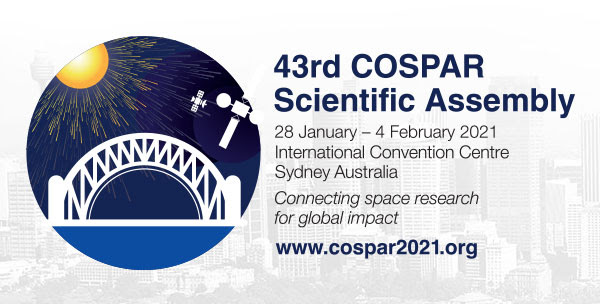
Message from the COSPAR President (28 January – 4 February 2021)
Government Inquiry into developing the Australian Space Industry

The Australian Government has announced an Inquiry into developing the Australian Space industry  Broadly, the Inquiry will report on a number of activities, including:

  • Development of space satellites, technology and equipment;
  • International collaboration, engagement and missions;
  • Commercialisation of research and development, including flow on benefits to other industry sectors;
  • Future research capacity, workforce development and job creation; and
  • Other related matters.

The Committee will focus on how the Australian Government can support and encourage the space industry while preserving and protecting the space environment.

Here are the Terms of Reference. Submissions to the Inquiry are due on 29 January 2021.

International Space University Discovery Day – 30 January

About this Event
Learn about the International Space University and talk about your higher education options in person online. Meet ISU faculty members, alumni and potential employers at our event! Tickets via Eventbrite.

Australian Space Agency Future SMLS Capability Consultation

The Australian Space Agency aims to grow and transform a globally respected national space industry. To achieve our broader goal of tripling the size of the space sector to $12 billion and creating up to 20,000 extra jobs by 2030, we are helping businesses participate in new local and global markets with funding and programs. We are consulting on the nature of current or planned near-term Australian space medicine and life sciences (SMLS) capabilities. This will help us develop an overview of the ambitions and plans of the Australian space industry and inform a roadmap for SMLS investment, collaboration and growth. Your information will also ensure opportunities align with the space industry’s current or planned activities, and shape other potential future opportunities for space access or funding.

Below you will find a link to an online consultation where you can provide input about the capabilities you are developing and the work you are undertaking in SMLS. You may also be aware of others working on SMLS in Australia or overseas, and you are encouraged to share this consultation link with them and your relevant networks.

The online consultation will be open for your input until midnight Canberra time, Sunday 7 February 2021. We look forward to your participation and ongoing engagement with this important and iterative process.

Future SMLS Capability Consultationhttps://consult.industry.gov.au/space/future-australian-space-medicine-and-life-sciences

Monash University Disaster Resilience Initiative Forum

First, we extend New Year Greetings to you all during this challenging COVID environment and hope 2021 will bring forth a healthy and new normal. Following last year’s successful MUDRI Forum, our first for 2021 will again be an interactive format using Zoom.
Date & time: Tuesday 16 February, 2021 9.00am – 1.00pm

The Forum will include the 15th Professor Frederick ‘Skip’ Burkle Annual Keynote Lecture, presented by Mr Jonathan Abrahams who is based in the Disaster Risk Reduction and Resilience Unit in Health Security Preparedness Department of the WHO Health Emergencies Programme in Geneva, Switzerland.

This Keynote Lecture advances/carries forward the theme of working together for the health, safety and wellbeing of communities, highlighting the evolution and directions for health emergency and disaster risk management (Health EDRM) and its potential applications in Australia and Oceania. The WADEM Oceania Chapter will co-host the Keynote Lecture.

We are honoured to announce Mr Abrahams as our Burkle Keynote Lecturer as he has played an instrumental role in global developments in Health EDRM over the past 10 years and brings the added benefit for us in that Jonathan is an Australian citizen with experience of working in emergency management in Australia and the Asia-Pacific region.

  • The program includes:
    • A reflection on the process and direction of community resilience in the emergency and disaster setting, as we mark 10 years since the release of the influential COAG National Strategy for Disaster Resilience, in February 2011. This topic will include a panel-led discussion about the implications of the Final Report of last year’s Royal Commission for community resilience;
    • A panel-led discussion on how to better integrate health and primary health care with emergency management arrangements – a recommendation from last year’s Royal Commission; and
    • Highlighting a rich potpourri of current developments and innovations in the sector.

The detailed program and further details will be available on the MUDRI website at https://www.monash.edu/muarc/research/research-areas/home-and-community/disaster-resilience or by contacting Samantha Bailey.

Please register your interest in participating in this free, on-line Forum by emailing Samantha Bailey at Samantha.bailey@monash.edu. Once you register your interest, we will provide you with the details about how to access the Forum.

Please feel free to share this invitation with your colleagues.
Frank, Caroline, Dudley, Suzanne and Samantha

Virtual symposium on human spaceflight – bioastronautics@hopkins

You are cordially invited to attend a virtual symposium on human spaceflight, Wednesday, Feb. 24, 2021, starting at noon EST. This is the first event of a new Special Interest Group at Johns Hopkins University, known as bioastronautics@hopkins. Expected speakers include physician and NASA astronaut Serena Auñón-Chancellor and N. Wayne Hale, Jr., Director of Human Spaceflight at Special Aerospace Services and former Space Shuttle Program Manager at NASA. Hale’s tenure as Program Manager included seven successful space shuttle flights. 

When: Wednesday, February 24, 2021, noon – 5 p.m., EST
Where: Microsoft Teams (a link will be forthcoming to those who RSVP)

The symposium will be the inaugural event for bioastronautics@hopkins, led by Mark Shelhamer, JHU Professor of Otolaryngology and former Chief Scientist of the NASA Human Research Program. This group will focus on bioastronautics, space medicine, and space life-sciences research, including habitat design and related engineering. Speakers will include Hale and Auñón-Chancellor, as well as faculty from various JHU organizations doing work in the field of human spaceflight. Johns Hopkins brings a broad range of expertise across several divisions, and plans to expand activities in this field of study, through its internal expertise and through collaborative efforts with other institutions.

This event is sponsored by the Commercial and Government Program Office in the JHU School of Engineering. A link through Microsoft Teams will be forthcoming to those who RSVP.

If you are interested in attending and have not responded already, please RSVP to lmclean@erg.jhu.edu. (RSVP is not mandatory or binding.) For more information about bioastronautics@hopkins, please visit the CGPO website.

One Planet – One Health

The resources on this page are all related to the inter-relationship between our precious blue planet, the space around it, and the good health and well-being of all creatures who live on and in the Earth. The satellites which we send into space and the applications drawn from them provide much valuable data for environmental monitoring and for use in disaster and infectious disease management (amongst other things). As our climate becomes more extreme and unpredictable, it is increasingly important to increase awareness and education about the impact that climate has on health (not just for humans) and biodiversity. The resources provided are related to Space4Health, the One Health initiative, and climate and environmental health.

the ad astra vita project

Please follow our blog (button below), and consider following our social media accounts on LinkedIn, Facebook and Twitter (links at the top of this page).

Our YouTube Channel contains all published videos from the recent Space Health Symposium plus additional videos and links. The remaining videos from the Symposium will be added in the near future.

The Space Health Symposium Program Page contains links to most of the presenter PDFs from the Symposium together with details about the program and links to the souvenir Program Booklet with details of all the presenters and their topics.

We also have many other fabulous Resources pages, so please explore our website, and if you would like to participate in any of our initiatives please contact us.

CAPCOM News – January 14, 2021

Conference on space and artificial intelligence technology

From the SGAC:
As many actors involved in the space industry are integrating or beginning to show their willingness to progressively integrate AI into their technologies, Euroconsult and Innovitech have created a unique event: AIxSPACE.

For the first time, this conference will bring together key stakeholders in space and artificial intelligence industries to allow everyone to obtain concrete information on these markets and connect with potential business partners, positioning themselves at the forefront of the sector.

To ensure the health and safety of participants, speakers and our teams, AIxSPACE will be held online on January 18 and 19, 2021, over two half days. The virtual format will offer a flexible event with plenty of networking time, content and participants! You can now register with a 10% discount, using the promo code AIXSPACE_AISSC. Register here.

Expert Review – WMO Research Board Task Team Statement on Meteorological and Air Quality factors affecting the COVID-19 pandemic

We are pleased to invite qualified experts to review the WMO Research Board Task Team Statement on Meteorological and Air Quality (MAQ) factors affecting the COVID-19 pandemic. We kindly ask for your help to share this draft with other qualified experts to encourage a strong technical review.

To participate in this technical review, kindly refer to the WMO Research Board COVID-19 Task Team website to download the document, access the review survey tool, and find descriptions of the scope, purpose, and intended audiences to assist your review. All comments should be submitted by 22 Jan 2021.

If you are unable to access Google Forms, a spreadsheet and email option is available on the above website. For additional questions, please contact climatehealthoffice@wmo.int

Please note: This is a “draft for technical review purposes only” and the information contained herein is subject to change. Information contained in this draft report should not be used by the media, governments or others for decision-making or other purposes until release of the final report in early 2021, following completion of the technical review process.

We sincerely thank you for your time and efforts to help improve our collective knowledge to address the global pandemic.

Kind regards,
The WMO Research Board Task Team on COVID-19, Air Quality and Meteorological Factors

7th Annual Space Traffic Management Conference – January 26-27, 2021

From the SGAC:
The Space Security and Safety (SSS) Program at The University of Texas at Austin’s Strauss Center and the Cockrell School of Engineering, in partnership with the International Academy of Astronautics (IAA), will hold the 7th annual Space Traffic Management conference, “Trust, But Verify: Incentivizing Compliance Through Shared Monitoring and Assessment.” The conference will take place virtually via Zoom webinar on Tuesday, January 26, 2021, and Wednesday, January 27. The conference is being organized by SSS Program Lead Dr. Moriba Jah, and non-resident SSS scholar Dr. Diane Howard.

This year’s conference, held virtually from 8 am – 12 pm CST, will begin with a 45-minute keynote and be followed by three 45-minute moderated panels with a Q&A each day.

Registration is required. Please note you must have a Zoom account and login to Zoom with the same email address you used to register. Students may register for free selecting the student option, but must be sure to register and login to Zoom using their .edu email address. Register here!

Experts from all over the world will virtually gather to discuss and exchange ideas on space traffic management. Technical sessions will range from topics including: Range Management, Airspace/Orbital Space Integration, Space Safety, Security, and Sustainability, Space Environment Effects and Impacts, and Related Issues (see the list at the bottom of the page for the areas breakdown). For video and audio of last year’s conference, please visit here. For more information, contact Ali Prince at ali.prince@austin.utexas.edu.

7th IAA Planetary Defense Conference – Call for abstracts

From the SGAC:
The International Academy of Astronautics will hold the 7th IAA Planetary Defense Conference on 26-30th April 2021. 

Virtually hosted by the UN Office for Outer Space Affairs (UNOOSA) in conjunction with ESA, the organizers are inviting to submit abstracts to present during the conference, and you have time until January 15 2021!

A broad theme of the conference is to identify the technologies, techniques, missions, data sets, and processes that most need development for an international program of planetary defense. You  can check the call for papers to see specific topics to be addressed.
Submit an abstract by January 15! Check the call for papers.

IAC 2021 Next Generation Plenary – Call for Applicants

See the newsletter for further information (too long to reproduce here). To apply, you must be a student or young professional, aged from 21 to 35 years old on 1st January 2021. Applications close on 22 January 2021.

OGC Seeking Information Concerning The Capture And Use Of Spatial Data During Health Emergencies

The Open Geospatial Consortium (OGC) seeks, in support of the OGC Health SDI Concept Development Study (CDS), to gather information concerning capturing, mapping, analyzing, modeling, and sharing spatial data to deal with major health emergencies. The Health SDI CDS will support the development of a Health Emergencies Data Model and the design of a Health Spatial Data Infrastructure (SDI). Responses are due by the 29th of January, 2021.

Solving Social Challenges in Mining Using Space Tech

Satellite Applications Catapult Spark Session from the UK, February 10th, 2021. Tickets via Eventbrite: Register here.

AmeriGEO training opportunities – February 2021

The Capacity Building community for AmeriGEO is proud to announce the first two training opportunities featured on the Inter-American Academy of Geosciences & Applications on behalf of a growing network of public and private institutions, academia, and commercial partners:
1) Flood Monitoring Using Synthetic Aperture Radar Data (Register Here)
2) Engaging with Indigenous Peoples (Register Here).

One Health Approach for Infectious Disease Outbreaks

National Academies of Sciences, Engineering, and Medicine: One Health Approach for Infectious Disease Outbreaks from Tuesday, February 23 to Thursday, February 25, 2021 (10AM-1PM EST/GMT-5).

Advancing Earth Observation Forum 2021 – Abstract call
KEY DATES

Abstract workshop and field trip submissions: Now open
Early bird registration: Now open
Abstract workshop and field trip submissions close: 9 April 2021
Early bird registration close: 24 May 2021
Standard registration: From 25 May 2021
Forum dates: 23 – 27 August 2021

Subscribe to the AEO 2021 mailing list to be notified of program releases, key event information and much more! SUBSCRIBE.

Wilderness Medical Society Webinars

Also consider signing up for the WMS “Trailblazer” email newsletter, which is packed full of interesting information (you do not have to be a member, but it is a great organisation to join and be part of).

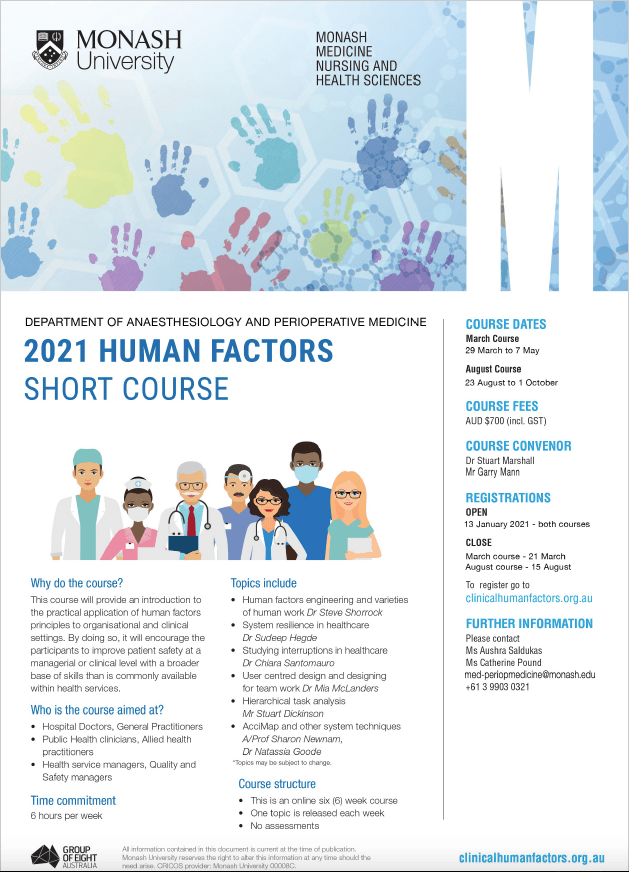
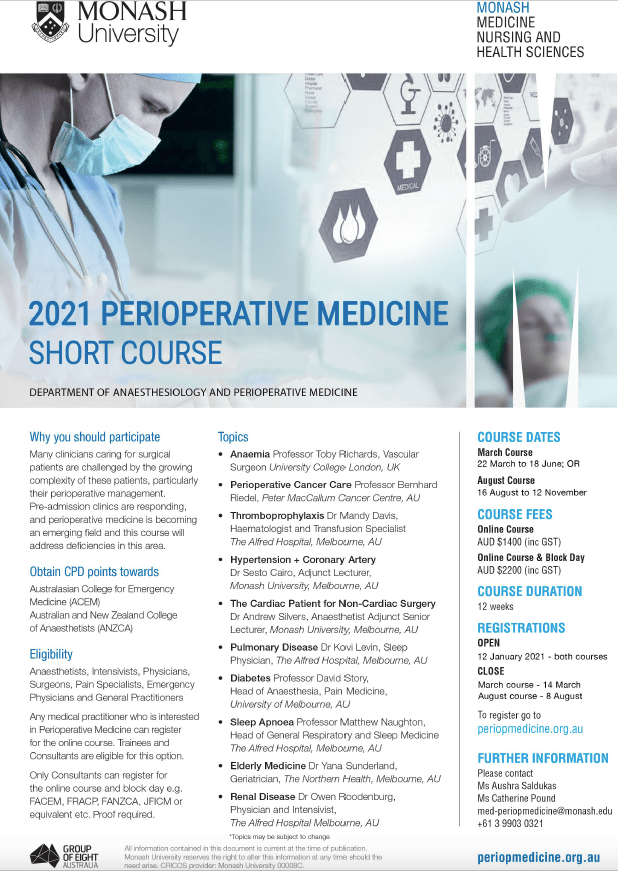
New short courses from the Department of Anaesthesiology and Perioperative Medicine, Monash University – Human Factors and Perioperative Medicine
Wilderness and Disaster Medicine Medical Student Elective

News brought to you by the University of Miami and the Wilderness Medical Society Wilderness and Emergency Medicine Lecture Series (sign up for the newsletter via the website):
New Elective Alert: Wilderness and Disaster Medicine Elective at Columbia University Medical Center, USA – May 2021
Who: Third and Fourth Year Medical Students
Description: A focus on medical care in resource-limited settings, including wilderness and disaster environments. By the completion of this course students will be familiar with the principles and practice of wilderness medicine, including environmental illness and injury (such as heat and cold illness), environmental toxicology, and the principles of patient care in disasters and mass casualty incidents. The curriculum is virtual, employing interactive case-based learning and simulation. PLEASE NOTE that a 4-5 night OPTIONAL backcountry experience is part of this course for local students but virtual content will be in place for visiting students. No experience necessary. Please contact the course directors for more information.
Contact: Raleigh Todman (rwt2111@cumc.columbia.edu

FAA Announces Final Rule to Facilitate the 
Reintroduction of Civil Supersonic Flight
(January 6, 2021)

WASHINGTON, DC — Today the U.S. Department of Transportation and the Federal Aviation Administration (FAA) issued a final rule to facilitate the safe development of civil supersonic aircraft. The rule streamlines and clarifies procedures to obtain FAA approval for supersonic flight testing in the United States.

“Today’s action is a significant step toward reintroducing civil supersonic flight and demonstrates the Department’s commitment to safe innovation,” said U.S. Transportation Secretary Elaine L. Chao.

This rule will help ensure that companies developing these aircraft clearly understand the process for gaining FAA approval to conduct flight testing, which is a key step in ultimately bringing their products to market.

“The FAA supports the new development of supersonic aircraft as long as safety parameters are followed,” said FAA Administrator Steve Dickson. “The testing of supersonic aircraft at Mach 1 will only be conducted following consideration of any impact to the environment.”

The Department and the FAA anticipate taking additional regulatory actions to enable the development of supersonic aircraft.

Federal Aviation Administration Adopts Stricter
Unruly Passenger Policy
(Press Release: January 13, 2021)

WASHINGTON – FAA Administrator Steve Dickson today signed an order (PDF) directing a stricter legal enforcement policy against unruly airline passengers in the wake of recent, troubling incidents.

The FAA has seen a disturbing increase in incidents where airline passengers have disrupted flights with threatening or violent behavior. These incidents have stemmed both from passengers’ refusals to wear masks and from recent violence at the U.S. Capitol.

“Flying is the safest mode of transportation and I signed this order to keep it that way,” Administrator Dickson said.

Historically, the agency has addressed unruly-passenger incidents using a variety of methods ranging from warnings and counseling to civil penalties. Effective immediately, however, the FAA will not address these cases with warnings or counseling. The agency will pursue legal enforcement action against any passenger who assaults, threatens, intimidates, or interferes with airline crew members. This policy will be in effect through March 30, 2021.

Passengers who interfere with, physically assault, or threaten to physically assault aircraft crew or anyone else on an aircraft face stiff penalties, including fines of up to $35,000 and imprisonment. This dangerous behavior can distract, disrupt, and threaten crewmembers’ safety functions.

The FAA has initiated more than 1,300 enforcement actions against unruly passengers during the past 10 years, including recent cases for allegedly interfering with and assaulting flight attendants who instructed them to wear masks.

While the FAA does not have regulatory authority over aviation security or no-fly lists, the agency works closely with federal law enforcement and national security partners on any reported security threats that may impact aviation safety.

Can you spread COVID-19 if you get the vaccine?

An informative article from Quartz recommended by today’s Nature Briefing.

Mars Society Announces New Monthly Blog – Red Planet Bound

As part of its effort to promote public understanding about the importance of exploring the planet Mars and the need to establish a permanent human presence there, the Mars Society is pleased to announce the launch of a new monthly blog called “Red Planet Bound”. 

Hosted on the Mars Society’s web site, the new online column is being written by Evan Plant-Weir HBSc, co-founder of The Mars Society of Canada. A passionate and long-time advocate of space exploration, Evan is also a talented writer, science communicator and content creator. 

The inaugural issue of the blog is called “To Mars, For Earth”.

Your feedback about the Red Planet Bound blog is very much welcomed.

Subscribe to NASA’s Newsletter

Join us as we explore and go forward to the Moon and on to Mars. Plus, discover the latest on Earth, the Solar System and beyond from NASA in your inbox.

TorqAid January 2021 Update

Hi everyone,
I wish you all a Happy New Year, and hopefully 2021 will have more of a silver lining than 2020. I’m enclosing the link to our January/February TorqAid Toolkit – see www.torqaid.com/torqaid-toolkit. This document includes key information for the global humanitarian or development practitioner. In particular I’d like to highlight:

Feel free to peruse this material, and share with interested friends and colleagues.
Cheers
Chris

Chris Piper
TorqAid Director
PO Box 13, Torquay VIC 3228, Australia

61 (0)412 497 317
pipercm@iprimus.com.au
www.torqaid.com
TorqAid Monthly Updates: http://eepurl.com/OoVsz
https://www.linkedin.com/in/chris-piper-148a4231/

U.S. Department of Transportation is Advancing Space Policy (Press release: December 9, 2020)

WASHINGTON — Today, the White House National Space Council issued its National Space Policy (PDF), a coordinated process for developing and monitoring the implementation of America’s space policy and strategy. The U.S. Department of Transportation (the Department) is a critical partner and recognizes that commercial space transportation capabilities have become the gateway to innovation in this growing sector of national and international aerospace endeavors.

“America is experiencing its most exciting years in space yet, and the Department is committed to working with the rest of the government to remove barriers to international competitiveness and ensure the safe operation of commercial space transportation activity,” said U.S. Transportation Secretary Elaine L. Chao.

From traditional rockets to space planes, the Department ensures the protection of the public, property, and national security and foreign policy interests of the U.S. during commercial launches and reentry activities. 

The Department is a standing member of the National Space Council and is involved in the production of space policy directives. Through the Federal Aviation Administration(FAA), the Department also encourages the growth of the U.S. commercial space transportation industry, signs cooperative agreements with other nations to promote the adoption of U.S. public safety standards and regulatory concepts, and supports commercial human exploration of space through a partnership with NASA.

The FAA also issues rules, regulations, and policies for commercial space transportation to ensure public safety and is testing new technologies to further enable the safe and efficient integration of space vehicle operations with other types of air traffic in the National Airspace System (NAS).

For example, the FAA recently streamlined and modernized its regulations governing commercial space launch and reentry licensing. The new rule facilitates greater growth and innovation in the aerospace industry, maintains public safety, and helps the U.S strengthen its leading position in the world. 

Thus far, the FAA has licensed more than 380 commercial space launches and re-entries, as well as 12 spaceport operators, located in eight states.

Additionally, the Department supports the National Space Policy’s new tasks to: improve the cybersecurity of GPS, its augmentations, and federally-owned GPS-enabled devices; foster all civil and commercial sector adoption of cyber-secure GPS-enabled systems; invest in capabilities to detect, analyze, mitigate, and increase resilience to harmful interference to Global Navigation Satellite Systems (GNSS); and, identify and promote use of multiple and diverse complementary positioning, navigation and timing (PNT) systems or approaches for critical infrastructure and mission-essential functions.

U.S. DOT Supports Record Number of Licensed Commercial Space Launches (Press Release: December 14, 2020)

WASHINGTON — The U.S. Department of Transportation is having a record year with supporting 35 licensed commercial space launches thus far in 2020 with the potential for even more before the year ends. The prior record of 33 was established in 2018.

“The record number of launches demonstrates this administration’s commitment to support the innovation and growth of the U.S. commercial space transportation industry and lead the world in aerospace capabilities,” said U.S. Transportation Secretary Elaine L. Chao.

For 2021, the Federal Aviation Administration (FAA) is forecasting a continued growth in licensed commercial space launches that could possibly reach 50 or more.

The 2020 commercial space launches cover a diversity of missions including the first FAA licensed crewed mission to the International Space Station (ISS), cargo-only resupply of the ISS, delivery of private enterprise satellites into orbit and the testing of space capsules and rocket systems. The launches occurred from seven locations both domestic and foreign:  Alaska, California, Florida, New Mexico, Texas, Virginia and New Zealand.

The FAA recently streamlined and modernized the regulations governing commercial space launch and reentry licensing as directed in the President’s May 2018 Space Policy Directive -2.  The new rule facilitates greater growth and innovation in the aerospace industry, maintains public safety, and helps the U.S strengthen its leading position in the world. 

An FAA license is required to conduct any commercial launch or reentry, the operation of any launch or reentry site by U.S. citizens anywhere in the world, or by any individual or entity within the United States. Once the FAA issues a license or permit, the agency works with operators to make sure they are meeting the requirements to conduct launches and reentries. This includes having FAA safety inspectors monitor licensed activities.

CAPCOM News – January 12, 2021

UPCOMING EVENTS

Space Specialists Space Mates Online – Space Sector Networking
Weekly event – next on Tuesday 12 January 2021

Space wants to kill us and the medications we take” webinar

Australian final-year medical student Vienna Tran is teaming up with the Liverpool Aviation and Space Medicine Society to present a webinar on “Space wants to kill us and the medications we take” on Sunday 24 Jan 2021 at 22:00 AEDT (GMT+11):

The ISU Adelaide Conference 2021 (online – tickets $20 to $100)
Friday 5 February – Saturday 6 February 2020
Theme: International Collaboration in Asia-Pacific Space Activities
Two free sessions are available at the conclusion of the formal program.

Website: https://www.adelaide.isunet.edu/program
Call for Speakers: https://www.adelaide.isunet.edu/callfortalks (closes on 25 January 2020).

Space Medicine and its Benefits for Health on Earth (online – tickets £5 to £7.50)
An interactive virtual student Aerospace Medicine conference from the University of Aberdeen Aviation and Space Medicine Society.
Saturday 6 February – Sunday 7 February 2021.

Website: https://spacemedabdn.wordpress.com/conference/
Call for speakers: https://docs.google.com/forms/d/e/1FAIpQLSdJtBpeJ5zFkynhhej4KqE-gKdZcuczV76O_nXxPOFucp1yWw/viewform (this has been extended to 22 January 2021).

PUBLICATIONS

SGAC Space Medicine and Life Sciences Division Newsletter – January 2020
Read about news, events, the webinar archive, and more!
https://mailchi.mp/spacegeneration/sgac_smls-january-2021-newsletter-04012021

The SGAC – Space Medicine and Life Sciences Journal Club is being revived. Read more in the newsletter, or  if you want to find out more about how you can listen to your contemporaries discuss ongoing research or if you want to present a paper yourself as part of our International Journal Club (#SMLS_JC), then follow @SGAC_SMLS for more details. If you already have a paper you wish to present and want to submit it for the first meeting please complete the submission form below – or email Alfred Hill for further information.

Journal Club Submission Formhttps://docs.google.com/forms/d/e/1FAIpQLSc4VXRBcCN8OEwIx9Z6oa2Gr1ciYy_hrU6HrJeUW5p7agvCfg/viewform.

IAF Young Professionals Newsletter – December 2020
Great reading material – an eclectic and interesting assemblage of articles!
https://www.iafastro.org/assets/files/publications/wd-ypp/december-2020-yp-newsletter-vol-2-issue-3.pdf

Events from the most recent AsMA newsletter:
MEETINGS CALENDAR 
Due to the coronavirus, please check the websites of meetings listed here to see if they have been postponed/cancelled. 

Fortnightly; International Astronautical Federation (IAF) Global Networking Forum Space Conversations Series; ONLINE, 14:00 Paris time. Please visit https://www.iafastro.org/events/iaf-gnf-space-conversations-series/ for more information. 

HFACS Workshops; ONLINE. Workshops on the The Human Factors Analysis and Classification System (HFACS) are now available online as well as in-person. For more info, please visit https://www.enrole.com/erau/jsp/course. jsp?categoryId=&courseId=HFAC for in-person and https://www.enrole.com/erau/jsp/course.jsp?categoryId= 558570F8&courseId=OHFA for online. 

Jan. 23-24, 2021; COVID-19: The Saga Continues – Successful Strategies for Keeping Safe at Work; VIRTUAL symposium. The American College of Occupational and Environmental Medicine (ACOEM) presents its third virtual symposium in a series of COVID-19 related symposia. For more info, please visit https://connect.acoem.org/s/lt- event?id=a1U3m00000MbB8LEAV

March 22-26, 2021; NATO Aerospace Medicine Summit; Garmisch Partenkirchen, Germany. Full details and registration are available at https://events.sto.nato.int/ index.php/upcoming-events/event-list/event/330

May 2-5, 2021; 105th American Occupational Health Conference (AOHC 2021); ONLINE. The American College of Occupational and Environmental Medicine’s (ACOEM’s) annual meeting. For more information, please visit https://acoem.org/Learning/American-Occupational- Health-Conference-(AOHC)

CAPCOM News – January 2020

The Space Generation Advisory Council is holding two events:

New Space Technologies and Opportunities: A discussion with space actors in the region

About this Event:
Space technology and its applications can be used to foster the development and implementation of Egypt Sustainable Development Strategy 2030. It models space programs and projects as a platform enhancing the implementation steps of many objectives and goals for Egypt vision 2030.

The Lunar surface has been permanently the next step to humankind. “We will be back on the moon” is the slogan of the approaching years. The Gateway is the new space station that would follow the International Space Station, the only crewed object in Space.

A discussion with the Chairman of the African Committee at the International Astronautical Federation and Space Operations located at the German Space Operations Center, Ahmed Farid. General introduction about SGAC by the regional coordinator of SGAC in the Middle East.

Health in Space Series: the Space Within – How to deal with psychological health in extreme environments & long duration missions in next generation human spaceflight?

About this Event:
Welcome back to the Health in Space series! In this sixth episode we will turn our attention to ‘the space within’: the human mind. This year, we celebrate that humans have lived and worked in the extreme environment of space for 20 years straight. For our series on health in space, it is time to look at the effects of this challenging endeavour on the mental health of astronauts and other professionals working in such harsh or isolated places.

Over the next decades, space missions returning to the Moon or even going further to Mars will take longer than a typical stay at the International Space Station. That will probably affect aspects of the human psyche of the astronauts on the go. But what mental effects will be of importance, when we will travel further away from Earth?

We have invited Dr. Iya Whitely and dr. Nathan Smith to join us on a tour through this exciting specialism in space health. What should we learn from the human mind before putting it under the stress of long duration space missions? What do we know from extreme environments on Earth and their habitants mental health? How do we work towards successful and healthy human space flight missions in the future?

  • Dr Iya Whiteley is a Space Psychologist (ESA, UKSA and IBMP) and the Director of the Centre for Space Medicine, Mullard Space Science Laboratory, University College London. She has 25 years of experience in space psychology, human performance and cognitive system engineering. Besides her background in clinical psychology, she has expertise in: crew selection & astronaut training, interface & cockpit design; human-robot interaction and humanoid robot design. Also, she is a pilot, skydiver, PADI Rescue Scuba Diver, and acupuncturist. Her book “TOOLKIT FOR A SPACE PSYCHOLOGIST”, was written to support astronauts in exploration missions to the Moon and Mars. Iya was expert and presenter for 6 episodes on the BBC Science show Astronauts: Do You Have What It Takes?
  • Dr. Nathan Smith obtained a PhD from the University of Birmingham in Sport and Exercise Psychology, after which he further specialized in extreme medicine. He developed training and education on psychology in extreme environments. Furthermore, Nathan has been a research fellow at the University of Manchester studying how humans survive and thrive in extreme environments, working together closely with ESA and NASA.

Our stellar panel will discuss astronaut psychological health for current and next generation space missions and at the end of the session we will open up the floor for questions. This session will be moderated by your host Jules Lancee, health innovator on Earth.

Space Health Symposium

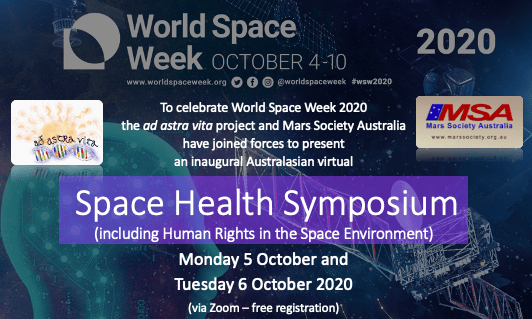
To celebrate World Space Week 2020 Mars Society Australia and the ad astra vita project have joined forces to present an inaugural Australasian virtual Space Health Symposium (including Human Rights in the Space Environment) to be held on Monday 5 October and Tuesday 6 October 2020 via Zoom (free registration).

We are excited to feature Human Rights in the Space Environment as the key plenary session on Day 2. That human space exploration is both expensive and dangerous is a given, but it also represents a unique set of circumstances where human beings are totally dependent on what is provided for them in order to be able to survive. However, as the good health (both physical and psychological) of expeditioners is essential for the success of the mission, spacefarers “need to thrive, not just survive”. As such, a strong human rights infrastructure is necessary to support this.

Members of the Australasian space life sciences and space law communities are especially invited to participate, but wherever you are in the world, you are welcome! University students are welcome, both as participants and potential presenters.

For more information and to register/submit an abstract, visit Space Health Symposium.

COVID-19 Pandemic

Here are some resources collated from providing public health advice (covers international statistics and USA and Australia-specific). (The text for resources 3-7 was provided by The Hill website.)

International

WHO situation reports
https://www.who.int/emergencies/diseases/novel-coronavirus-2019/situation-reports/

The Hill – Here are some of the best maps to track the coronavirus epidemic
https://thehill.com/changing-america/well-being/prevention-cures/487469-here-are-some-of-the-best-maps-to-track-the

Johns Hopkins University COVID-19 dashboard

Johns Hopkins University has developed an interactive web-based dashboard to visualize and track confirmed coronavirus cases in real-time. The dashboard illustrates the location and number of confirmed COVID-19 cases, deaths and recoveries for all affected countries. It was developed to provide researchers, public health authorities and the public with a user-friendly tool to keep tabs on the outbreak as it unfolds. (or go to https://coronavirus.jhu.edu/map.html).

The World Health Organization COVID-19 dashboard

The World Health Organization has made a similar map available that breaks down the number of confirmed cases, deaths, and countries, areas or territories with cases. 

Nextstrain COVID-19 dashboard

Nextstrain is an open-source project that tracks pathogen genome data. Its map is more technical and provides more information about how the disease has spread. It breaks down the genome of the virus, alongside a map showing how the virus has traveled country to country. 

The New York Times COVID-19 dashboard

The New York Times offers easy-to-read charts and graphs, as well as text stats breaking down the situation around the world. 

nCoV2019.live COVID -19 dashboard

A 17-year-old computer whiz from Seattle built an interactive map to keep the world updated on the COVID-19 pandemic. The website has been visited by 12 million people since it was launched by Avi Schiffmann in December, according to The Times of Israel. The site automatically scrapes data from sources all around the world and updates every minute. It offers stats on confirmed cases, serious cases, deaths and recoveries.

Worldometers – includes both statistics and graphs
https://www.worldometers.info/coronavirus/country/us/

The Washington Post – Why outbreaks like coronavirus spread exponentially, and how to “flatten the curve”
https://www.washingtonpost.com/graphics/2020/world/corona-simulator/

The Lancet – COVID-19 and Italy: what next?
https://www.thelancet.com/journals/lancet/article/PIIS0140-6736(20)30627-9/fulltext

Coronavirus: Why You Must Act Now
https://medium.com/@tomaspueyo/coronavirus-act-today-or-people-will-die-f4d3d9cd99ca

Europe’s Doctors Repeat Errors Made in Wuhan, China Medics Say
https://www.bloomberg.com/news/articles/2020-03-17/europe-s-doctors-getting-sick-like-in-wuhan-chinese-doctors-say

stayinghomeclub – A list of all the companies WFH or events changed because of COVID-19
https://stayinghome.club/ (contributions to the lists are accepted)

Hygiene resources

Good technique for hand washing and using hand sanitiser
https://www.who.int/gpsc/5may/background/5moments/en/
In studies, washing hands with soap and water for 15 seconds (about the time it takes to sing one chorus of “Happy Birthday to You”) reduces bacterial counts by about 90%. When another 15 seconds is added, bacterial counts drop by close to 99.9%.
https://www.health.harvard.edu/newsletter_article/The_handiwork_of_good_health

Posters
https://www.dhhs.vic.gov.au/promotional-material-coronavirus-disease-covid-19

Persistence of coronaviruses on inanimate surfaces and their inactivation with biocidal agents
https://www.sciencedirect.com/science/article/pii/S0195670120300463

Australia-specific

Australia – Victorian Department of Health COVID-19 health alerts
https://www2.health.vic.gov.au/about/news-and-events/healthalerts/2019-Coronavirus-disease–COVID-19

Australian Government Department of Health
COVID-19 resources
https://www.health.gov.au/resources/collections/novel-coronavirus-2019-ncov-resources
COVID-19 health alerts
https://www.health.gov.au/news/health-alerts/novel-coronavirus-2019-ncov-health-alert

General health advice
https://www.dhhs.vic.gov.au/victorian-public-coronavirus-disease-covid-19

SmartTraveller – COVID-19 Advice
https://www.smartraveller.gov.au/COVID-19-australian-travellers

Information about international outbound travel insurance and cancellation, etc.
https://www.smh.com.au/national/many-international-flights-won-t-be-refunded-despite-new-travel-advice-20200313-p549xn.html?fbclid=IwAR3_ls2DlzGKHjAS33dVx8Gpq166sOwsKmoH_so6zjSF4X9F18ITZtBZ61c (the situation has changed now as the Australian Government Travel Advisory has been lifted to Level 4 – check what your airline is offering by way of refunds or credits or flight changes).

USA-specific

USA CDC
https://www.cdc.gov/coronavirus/2019-ncov/cases-in-us.html

USA CDC – Get Your Mass Gatherings or Large Community Events Ready
https://www.cdc.gov/coronavirus/2019-ncov/community/large-events/mass-gatherings-ready-for-covid-19.html

USA CDC – Resources for Large Community Events & Mass Gatherings Before and During an Outbreak
https://www.cdc.gov/coronavirus/2019-ncov/community/large-events/index.html

USA CDC – FAQs for Event Organisers and Individuals
https://www.cdc.gov/coronavirus/2019-ncov/community/large-events/event-planners-and-attendees-faq.html

USA CDC – Implementation of Mitigation Strategies for Communities with Local COVID-19 Transmission
https://www.cdc.gov/coronavirus/2019-ncov/downloads/community-mitigation-strategy.pdf

USA CNN – State by State breakdown
https://edition.cnn.com/2020/03/03/health/us-coronavirus-cases-state-by-state/index.html

SmartTraveller – Advice re USA
https://www.smartraveller.gov.au/destinations/americas/united-states-america

Time Magazine – Here’s how fast the virus could infect over 1 million Americans
https://time.com/5801726/coronavirus-models-forecast/

Atlanta Magazine – Coronavirus cancels Atlanta
https://www.atlantamagazine.com/news-culture-articles/coronavirus-cancels-atlanta/

Other

AsMA Announcements
https://www.asma.org/news-events/announcements

Featuring Mars Society Australia

MSA Goals:

Mars is within reach.  The fourth planet from the sun, the Red Planet, is a potential new frontier for humanity. It is the nearest body in the Solar System known to possess all the mineral resources necessary to sustain a permanent human presence.  It has landscapes billions of years old that can shed light on the early history of the Earth and the Solar System. Understanding of its climatic history will help scientists understand the operation of the Earth’s climate. Mars is the next most likely place in the Solar System where life may once or may still exist, the discovery of which would offer deep insights into the origins of life and the biological sciences.

In the last decade, major strides toward feasible, affordable human missions have been made and the question is no longer, “Can humans go?” but “When will humans go?”

  1. Broad public outreach to instil the vision of pioneering Mars.
  2. Support of more aggressive government funded Mars exploration programs around the world.
  3. Conducting Mars exploration on a private basis.
  4. Encourage Australian participation in planetary sciences and engineering in education, industry and government.

The MSA is undertaking comparative research and testing surface exploration strategies and technologies in renowned Mars analogue locations. Our vision is to position Australia for participation in the eventual establishment of a human presence on Mars, and to make Mars more real as a place for people everywhere.

Joining MSA

Various types of membership are available:

TypeNewRenewing
RegularA$115A$70
FamilyA$125A$80
StudentA$90A$40
SeniorA$90A$40
ContributingA$165A$120
(As at 24 January 2020)

Membership of Mars Society Australia offers the following benefits:

  • For new members, all have the option of the following as joining gifts:
    • The latest copy of Dr Robert Zubrin’s book “The Case For Mars”, initialled by Dr. Zubrin, or
    • A copy of Guy Murphy’s book, “Mars, A Survival Guide”.
  • A reduced ticket price for AMEC (Australian Mars Exploration Conference).
  • Opportunities to meet with other MSA members at regular branch events and online..
  • Opportunities to participate in MSA activities such as Spaceward Bound Australia expeditions, and projects such as the Starchaser Rover, MarsSkin and Mars-Oz Habitat.
  • The knowledge that you’re supporting Australia’s most pro-active and well-respected space advocacy group.

MSA has branches all around Australia, and there is a wealth of information about events, resources, research and education on the MSA website: https://www.marssociety.org.au/.

Featuring the Australasian Society of Aerospace Medicine (ASAM)

The aims of ASAM are:

  • To cultivate and promote aviation medicine and related sciences;
  • To provide an authoritative body of opinion on matters of aviation medical significance; and
  • To increase the awareness of the aviation industry, government, and the general public of the importance of aviation medicine to flight safety.

Membership of ASAM is open to individuals and organisations. Students are welcome. Current membership fees (as at 24 January 2020) are:
Membership Fees
Full Membership – $143
Associate Membership – $143
Student Membership – $66

ASAM publishes a refereed journal (JASAM) on a half-yearly basis. It welcomes any contributions such as short cases, copies of papers presented at ASAM meetings, interesting photographs of our members in action or items of general interest to practitioners of aviation medicine. Send them by e-mail to the Editor.

The Editor of JASAM is:
Dr David Fitzgerald
Email: editor@asam.org.au

JASAM is now published online at https://www.exeley.com/journal/journal_australiasian_society_aerospace_medicine

ASAM also offers a number of awards, prizes, research grants and scholarships for students. For more information see: https://www.asam.org.au/asam-awards-prizes-grants.

A great deal more information is available on ASAM’s website: https://www.asam.org.au/.

Welcome to our new ‘beta’ website

Welcome to the new ‘beta’ website for the ad astra vita project!

We are hoping that this exciting new initiative provides an opportunity for the whole Australian space life sciences community to participate and “advertise its wares” to the world. We also hope that this will result in increased linkages and collaborations, and consultancy opportunities for those who are keen “to get a foot in the door”.

This is your resource, so please get involved! We would love to hear from people and organisations who are interested in being listed in the Showcase compendium or who would like to join the consultancy team, and if you have a “medicine in extreme environments” link or resource that you would like to share, please let us know!

We look forward to hearing from you!

Dr Rowena Christiansen, founder of the ad astra vita project